How to Pack Dishes, Glassware, and Kitchen Items for a Move
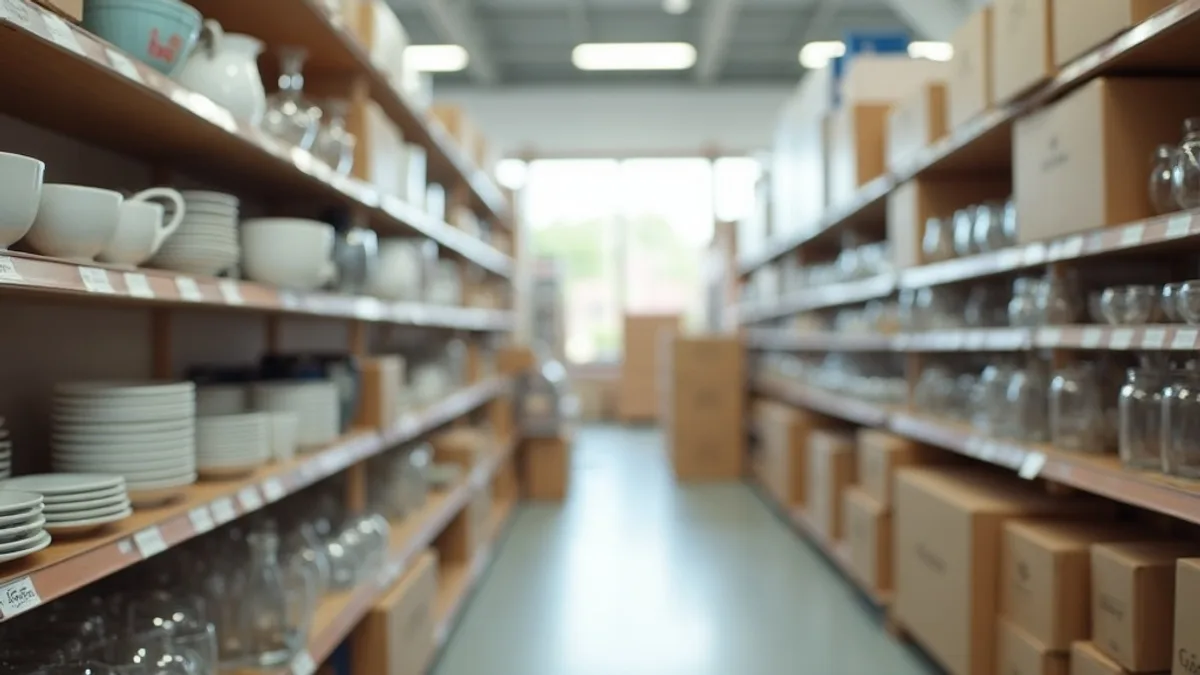
## Why do kitchen boxes break more than any other?
Three reasons. Kitchen items are dense, so the box is heavy. Kitchen items are mostly fragile, so any shock breaks something. And people pack kitchens last, in a hurry, with whatever boxes are left over.
Move-day damage data from [the American Moving and Storage Association](https://moving.org/) consistently puts dishware and glassware at the top of the broken-items list. The cause is almost always the same: wrong box, no cushion, plates packed flat instead of vertical.
This guide fixes all three.
## What boxes do I need for kitchen items?
You want dish-pack boxes for fragile kitchen contents and standard medium boxes for everything else. A dish-pack is a double-walled corrugated box, typically 18 by 18 by 28 inches, with the structural strength to carry sixty-plus pounds of plates without crushing.
| Item | Box Type | Approx. Capacity |
|---|---|---|
| Plates, bowls, serving dishes | Dish-pack (5.2 cu ft) | 30-50 pieces |
| Glasses, stemware, mugs | Dish-pack with cell dividers | 24-48 glasses |
| Pots and pans | Medium box | Full nested set |
| Small appliances | Medium or large box | 1 per box, original packaging if possible |
| Pantry items | Small box | Stacked tightly |
| Knives and sharp utensils | Small box, blades wrapped | Wrapped individually |
[U-Haul](https://www.uhaul.com/MovingSupplies/Boxes/) and [The Home Depot](https://www.homedepot.com/b/Storage-Organization-Moving-Supplies/N-5yc1vZc8mn) sell dish-packs, but you can also pick them up from [our packing supplies counter](/packing-supplies-radcliff-ky) along with cell dividers and unprinted paper.
## How do I pack plates without breakage?
Pack plates vertically, on their edge, never flat. The rim of a plate is the strongest part. The flat face is the weakest. When boxes get stacked during a move, vertical plates transfer load around the rim. Flat plates transfer load through the face, and they crack.
The method:
- Crumple a four-inch layer of paper at the bottom of the dish-pack
- Wrap each plate individually in two sheets of unprinted paper
- For china or thin plates, add a third sheet
- Stand plates vertically along the long edge of the box, like records in a milk crate
- Pack tight enough that plates do not shift if you tip the box
- Add a layer of paper between rows
- Top with another four-inch layer of crumpled paper
- Tape with the H-tape method, label THIS END UP and FRAGILE
A standard dish-pack holds about 30 dinner plates this way, plus salad plates and bowls in the gaps.
## How should I pack glasses and stemware?
Glasses live or die based on whether they touch each other. The fix is the cell-divider insert: a corrugated grid that drops into a dish-pack and creates individual cells for each glass.
For each glass:
1. Stuff the bowl of the glass with crumpled paper to support it from inside
2. Wrap the glass in two full turns of paper, including the stem and foot for stemware
3. Place each wrapped glass in its own cell of the divider
4. Top with a layer of paper, then a second layer of cells if the divider stacks
5. Crumple paper across the top so nothing shifts when the box is closed
Stemware is the most likely thing to break because the stem is a stress concentrator. The internal paper-stuffing trick adds support from inside and dramatically cuts breakage. [North American Van Lines](https://www.northamerican.com/moving-tips/packing-tips/dishware) and [United Van Lines](https://www.unitedvanlines.com/moving-tips/packing-tips) both teach this method to their packers.
## What about pots, pans, and bakeware?
Pots and pans are the easy part of a kitchen move. They are not fragile, but they are awkward and they scratch each other.
- Nest pots and pans by size with a sheet of paper between each
- Put lids inside their pots, also with paper between
- Cast iron goes in its own box, on the bottom of the box. It is heavy enough to crush other items
- Bakeware (cookie sheets, pyrex, etc.) wraps individually in paper
- Pyrex and other glass bakeware needs the same treatment as plates: vertical, individually wrapped
## How do I pack knives and sharp utensils safely?
Knives need two layers of protection: one for the blade, one for the box.
Wrap each knife blade in a folded piece of corrugated cardboard, taped closed. This is the [knife guard method](https://www.thespruce.com/how-to-pack-knives-when-moving-2436188). Then wrap the entire knife in paper. Put all wrapped knives in a single box, blade-down, with a layer of crumpled paper at the bottom and top.
Label the box KNIVES, OPEN WITH CARE on every side. Movers and unpackers cut themselves on knife boxes more than any other category.
## What about small appliances?
If you kept the original boxes (toaster, blender, coffee maker), use those. They are designed for the exact item and they outperform anything you can rebuild.
If you did not keep the originals:
- Remove all loose parts (blades, carafes, baskets)
- Wrap each piece in paper or bubble wrap
- Place the appliance in a medium box with at least three inches of cushioning on all sides
- Put loose parts in a labeled bag inside the same box
- Label the box with the appliance name so you can find it on day one
## How heavy should each box be?
A loaded dish-pack should not exceed 65 pounds. A medium box should not exceed 50. Heavy boxes split, get dropped, and break backs. The [OSHA lifting guideline](https://www.osha.gov/ergonomics/guidelines/retailgrocery) for repetitive lifting peaks around 50 pounds for trained adults.
If a box feels like it might be too heavy, repack it. The rule of thumb: lift with one hand. If it takes two and your knees, redistribute.
## What supplies do I actually need?
For a typical three-bedroom kitchen pack:
- 4-6 dish-pack boxes
- 2-3 cell divider sets
- 6-8 medium boxes
- 2-3 small boxes
- 5 pounds of unprinted packing paper (about 200 sheets)
- 2 rolls of bubble wrap (medium and small bubble)
- 4 rolls of two-inch packing tape
- One thick black marker
Total cost from [our store](/packing-supplies-radcliff-ky) runs roughly 90 to 130 dollars. Buying retail at a big-box store runs higher.
## Should I pack myself or hire a pack-and-ship store?
Pack yourself if you have time, materials, and a non-fragile-heavy kitchen. Hire it out if:
- You are short on time before move day
- You have heirloom china or expensive stemware
- The move is long-distance and shock load is higher
- You are storing the boxes for more than 30 days
- You want carrier insurance to actually cover breakage
Horizon Pack and Ship packs kitchens at both locations. Radcliff: 734 Knox Blvd, (270) 319-4145. Elizabethtown: 207 Towne Dr, (270) 900-1553. Hours are Monday through Saturday, 9 AM to 6 PM. We also pre-pack supply bundles you can take home if you want to do it yourself but want the right materials.
If you are also looking for a [moving truck rental in Radcliff or Elizabethtown](/moving-truck-rental-radcliff-elizabethtown-ky), we handle that under the same roof. Pack the kitchen right and the rest of the move gets easier.
About the author

Justin Fernandez
Owner, Horizon Pack and Ship
Justin Fernandez owns Horizon Pack and Ship, with retail shipping locations in Radcliff and Elizabethtown. HPNS is an authorized UPS, FedEx, DHL Shipping Outlet and a USPS Approved Postal Provider serving home-based businesses, government contract winners, military families, and Hardin County residents.
Read full bio →