
How to Ship Internationally from Elizabethtown, KY: A Complete Guide
How to Ship Internationally from the Elizabethtown, KY Step by Step
Shipping a package internationally can feel complicated, but the process is straightforward when done correctly. This guide explains exactly how to ship internationally from the US, what documents you need, and how to avoid common mistakes that cause delays or extra fees.
Actionable Guide for Step 1. Where to Find the Official Rules
There are two primary reliable sources for this information:
A. Major Carrier Databases (The Easiest Route) The major international shipping carriers maintain massive, constantly updated databases of country-specific regulations. Even if you end up using a different carrier, their tools are excellent for research.
UPS: Look for their "Country Regulations" or "Import/Export" tools.
FedEx: Their "International Shipping Guide" and "WorldTariff" tools are very detailed.
DHL: As the most extensive international carrier, their "Capability Tool" and customs advice pages are highly accurate for obscure destinations.
USPS (For US Shippers): The International Mail Manual (IMM) is the bible for mailing out of the USA. You can select the destination country and see a neat list of prohibitions and restrictions.
B. The Destination Country’s Customs Website (The Ultimate Authority) If you are shipping something unusual or high-value, always double-check with the source. Search for "[Country Name] Customs agency" or "[Country Name] consulate import regulations." Government websites can be hard to navigate, but they are the final word.
2. Deep Dive into the Checklist
Here is what those categories you listed actually mean in practice:
Prohibited Items (The "Absolutely Not" List) These items will be seized. Do not attempt to hide them; X-rays will find them.
Obvious examples: Narcotics, illicit weapons, counterfeit goods, ivory.
Surprising examples: Some countries prohibit used clothing (to protect local textile industries), specific types of literature or media deemed culturally offensive, or even playing cards.
Restricted Materials (The "Yes, But..." List) These items can be shipped, but only if you have specific permits, licenses, or adhere to strict packaging limitations.
The Big One: Lithium Batteries. Almost every electronic device has them. They are highly restricted due to fire risk on planes. You must follow rigid packaging and labeling rules.
Alcohol and Tobacco: Usually require specific import licenses by the receiver and are heavily taxed.
Food and Agriculture: Seeds, soil, meats, and cheeses are often restricted to prevent pests and diseases.
Size and Weight Limits This isn't just about what fits on the plane.
Some countries have undeveloped postal infrastructure and cannot handle pallets or packages over 70 lbs for residential delivery.
Exceeding size limits often triggers massive "oversize" surcharges or forces you into freight shipping instead of parcel shipping.
Customs Requirements (The Paperwork Pre-check) Before packing, you need to know what paperwork the country demands to clear the goods.
Does the country require a specific format for the Commercial Invoice?
Does the receiver need an import license or tax ID number before you ship? (Very common in Brazil, China, and Russia).
Summary of Step 1 Risks
If you fail this step, here are the three most likely outcomes:
Carrier Refusal: The shipping company (FedEx/UPS/USPS) will refuse to accept the package at the counter because their system flags the contents.
Customs Seizure/Destruction: The package arrives in the destination country, is inspected, and the prohibited items are destroyed. You do not get a refund on the goods or shipping.
Return to Sender (RTS): The foreign customs rejects the package and sends it back. You are usually charged for the return shipping costs, which are often higher than the original outbound cost.

Actionable Guide for Step 2: Choosing Your Carrier
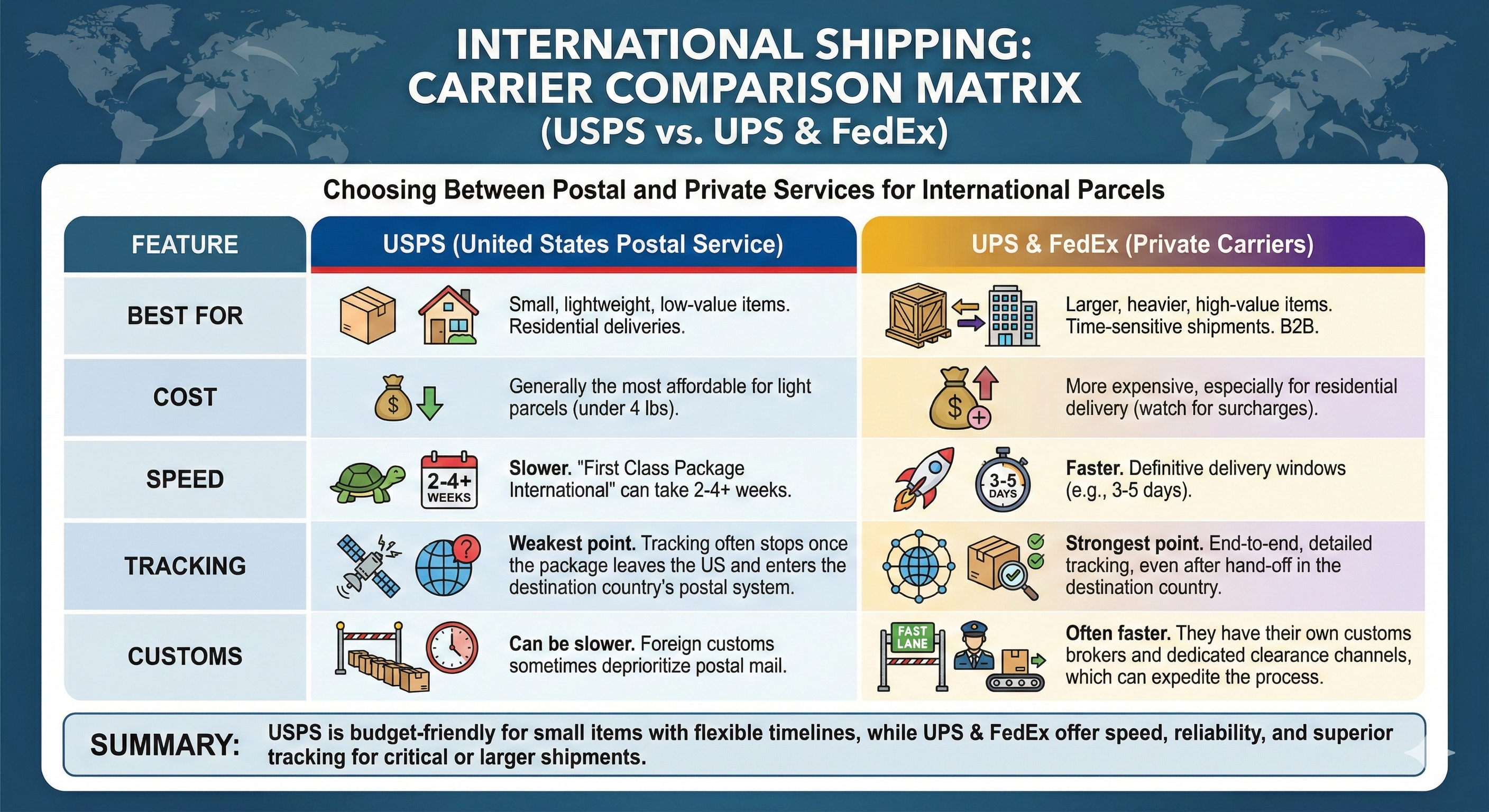
Don't just pick one and stick with it for everything. The "best" carrier changes depending on what you are shipping and where it's going.
2. The "Secret Sauce": Express vs. Standard
This is a critical distinction within each carrier's offerings.
Standard/Economy Services (e.g., USPS First Class, UPS Worldwide Expedited): These are cheaper but slower. The carrier focuses on filling trucks and planes to lower costs, not on speed. They are more likely to get stuck in general customs queues.
Express/Priority Services (e.g., USPS Priority Mail Express, UPS Worldwide Express, FedEx International Priority): You are paying a premium for speed and priority.
Why it matters for customs: In many countries, express packages are sorted into a different, faster queue for customs clearance. The carrier's in-house brokers actively work to clear these shipments first. For time-sensitive or high-value items, the extra cost of Express is often worth it to avoid customs limbo.
3. Your Decision Checklist
For every international shipment, ask these three questions to pick the winner:
What is the package's weight and size?
Under 4 lbs and small? Lean towards USPS for cost savings.
Over 4 lbs or large? UPS/FedEx rates become much more competitive, and their handling of larger boxes is better.
What is the item's value and is it time-sensitive?
Low value (<$50) and not urgent? USPS is fine. The risk of poor tracking is acceptable for the cost savings.
High value (>$200) or urgent? Pay extra for UPS or FedEx. The superior tracking and faster customs clearance are a necessary insurance policy. You need to know exactly where that expensive item is.
Where is it going?
Major developed nation (UK, Canada, Germany, Japan)? USPS tracking handoffs are usually okay.
Developing nation with unreliable postal service (parts of South America, Africa, Southeast Asia)? Do NOT use USPS. Once it hands off to the local post, it may vanish. Use UPS or FedEx for their reliable end-to-end control.
Summary of Step 2
USPS is your budget-friendly friend for small, non-urgent items, but accept that tracking might vanish.
UPS/FedEx are the reliable professionals for larger, valuable, or urgent shipments, but you'll pay a premium for their superior tracking and customs handling.
Express Services are not just about delivery speed; they are often a "fast-pass" through foreign customs.

Ready for the next phase?
Now that you know what you're shipping and who is taking it, you need to figure out the total price tag.

Actionable Guide for Step 3: Calculate the Total "Landed Cost" (The Financial Reality Check)
This is the most complex and financially dangerous step. The "landed cost" is the total price to get the product into your customer's hands.
The Formula: Landed Cost = Product Price + Shipping Cost + Insurance + Duties & Taxes + Carrier Surcharges
If you get this wrong, one of two things happens:
You eat the unexpected costs and lose money.
Your customer gets a surprise bill for $50+ at their door, refuses the package, and you lose the sale and pay for return shipping.
Calculating Landed Cost
1. The Big Decision: DDP vs. DDU Before you calculate, you must decide who is paying the duties and taxes.
DDU (Delivered Duty Unpaid) / DAP (Delivered at Place):
How it works: You pay for shipping. The recipient is contacted by the carrier at the destination to pay all duties, taxes, and brokerage fees before delivery.
Pros: Cheaper upfront for you. Less paperwork.
Cons: Terrible customer experience. It feels like a ransom demand. High rate of refused packages.
DDP (Delivered Duty Paid):
How it works: You calculate and collect all duties and taxes from the customer at checkout (or build it into your price) and pay the carrier to handle it. The customer receives the package with zero friction.
Pros: Excellent customer experience. No surprises.
Cons: Requires more complex calculations upfront. You take the risk if your calculation is wrong.
2. How to Estimate Duties & Taxes
Use Carrier Tools: UPS, FedEx, and DHL have sophisticated "Landed Cost Calculators" on their websites. You enter the destination, item value, and description, and they give you an estimate. This is the easiest method.
Find the HS Code (The Accurate Method): Every product has a 6-to-10-digit "Harmonized System" (HS) code used by customs worldwide.
Example: A cotton t-shirt might be
6109.10.You can look up the duty rate for that specific code in the destination country's tariff schedule. This is more work but much more accurate.
Don't Forget Sales Tax (VAT/GST): Duties are on the type of good. VAT (Value Added Tax) or GST (Goods and Services Tax) is a general sales tax applied to the total value (product + shipping + duty) in many countries (e.g., 20% in the UK). This is often a bigger chunk of change than the duty itself.
Actionable Guide for Step 4: Package the Item Correctly (Prepare for Battle)
Now that the financials make sense, it's time to pack. You are absolutely correct: international packages face a much wider variety of threats than domestic ones.
Your package will face:
Drops from automated sorting conveyor belts (sometimes 4-6 feet).
Compression from hundreds of pounds of other cargo stacked on top of it in a container or cargo plane belly.
Vibration from trucks and planes for hours on end.
Humidity and Temperature Swings in cargo holds.
Actionable Guide to International Packaging
Your list is a perfect starting point. Here is how to execute it:
The Golden Rules:
The "Shake Test": Once packed, seal the box and shake it hard. If you hear or feel anything moving inside, it fails. Open it and add more dunnage (bubble wrap, paper, foam). Movement is the primary cause of damage.
Use Rigid, New Boxes: Do not reuse old, weak diaper or cereal boxes. Use a new, single-wall corrugated box for light items, and a double-wall box for anything over 10 lbs or fragile. The structural integrity of a box degrades with every use.
Double-Box Valuables: This is non-negotiable for electronics, glass, or high-value items.
Pack the item securely in a smaller box.
Place that box inside a larger box with at least 2 inches of cushioning (packing peanuts, air pillows) on all six sides.
H-Tape Seal Method: Do not just put one strip of tape down the middle. Use the "H-tape" method: tape down the center seam, then tape across the side seams on both the top and bottom of the box. This seals all open edges and adds significant structural strength.
A Clean Slate: As you noted, remove all old labels, barcodes, and markings. A stray domestic barcode can confuse an automated scanner in a foreign country and send your package to the wrong city, adding weeks to the delivery time.
Pro Tip: The "Inside Job": Place a duplicate copy of the shipping label and commercial invoice inside the box, right on top of the items. If the outer label gets ripped off in transit, customs can open the box, find the documents, and still deliver it.

Moving on to the final administrative hurdle! You’ve calculated the costs and packed the item "for battle." Now, you need to ensure the package actually makes it across the border.
Actionable Guide for Step 5: Create Accurate Customs Documentation
(The Commercial Invoice & Beyond)
Think of customs documentation as the passport and visa for your package. If the "passport" is missing information or looks suspicious, the package gets detained at the border (Customs), leading to delays, storage fees, or total rejection.
1. The Commercial Invoice: The Master Document
For almost all international shipments, the Commercial Invoice (CI) is the primary document used by customs authorities to determine duties and taxes.
Be Specific with Descriptions: Never write "Gift" or "Parts." Use the "What, Why, and Material" rule.
Bad: "Shirt."
Good: "Men’s 100% Cotton Knitted T-Shirt."
The HS Code: As mentioned in Step 3, include the 6–10 digit Harmonized System code. This removes any ambiguity for the customs officer.
Declared Value: This must be the transaction value (what the customer paid). Under-declaring value to save on taxes is considered "devaluation fraud" and can result in heavy fines or your business being blacklisted.
Country of Origin: State where the product was actually manufactured (e.g., "Made in Vietnam"), not just where it is shipping from.
2. Postal Declarations (CN22 vs. CN23)
If you are shipping via a national postal service (like USPS, Royal Mail, or Canada Post), you will use a CN22 or CN23 form.
CN22: For low-value items (typically under $400 USD). Usually a small sticker.
CN23: For higher-value or heavier items. A more detailed form often tucked into a plastic pouch.
3. Execution Best Practices
To ensure your paperwork doesn't get lost or ignored:
The "Rule of Three": Print three copies of the Commercial Invoice. One goes inside the box (The "Inside Job" mentioned in Step 4), and two go into the clear "Packing List Enclosed" pouch on the outside of the box.
Sign in Ink: Many countries still require a physical, handwritten signature on the commercial invoice to prove its authenticity. Use a blue or black pen.
Digital Data (EDI): If your shipping software supports it, use Electronic Trade Documents (ETD). This sends the customs data to the carrier digitally before the package even arrives, often speeding up clearance significantly.
Pro-Tip: If you are shipping "Gifts" between individuals, you still need an invoice, but it is often called a Pro-forma Invoice. It looks identical to a Commercial Invoice but is used when no money is changing hands for the specific shipment.

Actionable Guide for Step 6: Pay Duties and Taxes (The "Hand-off")
The 2026 landscape has changed significantly, especially for shipments to the U.S. Following the removal of the $800 de minimis exemption, almost every international package now faces a "financial hand-off."
1. Who is paying?
DDP (Delivered Duty Paid): The Sender (You) Pays. You collect the tax at checkout and pay the carrier. This is the gold standard for customer experience—the package arrives at the door with no extra charges.
DDU/DAP (Delivered Duty Unpaid): The Recipient Pays. The carrier will contact your customer and demand payment before they release the package.
Warning: This often results in "Surprise Bills." Many customers will refuse the package, and you will be stuck paying for the return shipping.
2. The 2026 "Flat Fee" Reality
If you are using national postal services (like USPS or Royal Mail) to ship to the U.S., be aware of the Tariff Band System. Many postal shipments now face a flat entry fee ($80, $160, or $200) based on the item's category, rather than a percentage of the value. Always verify these fees before choosing your shipping method.
Actionable Guide for Step 7: Track and Monitor the Shipment
(Managing the "Customs Black Hole")
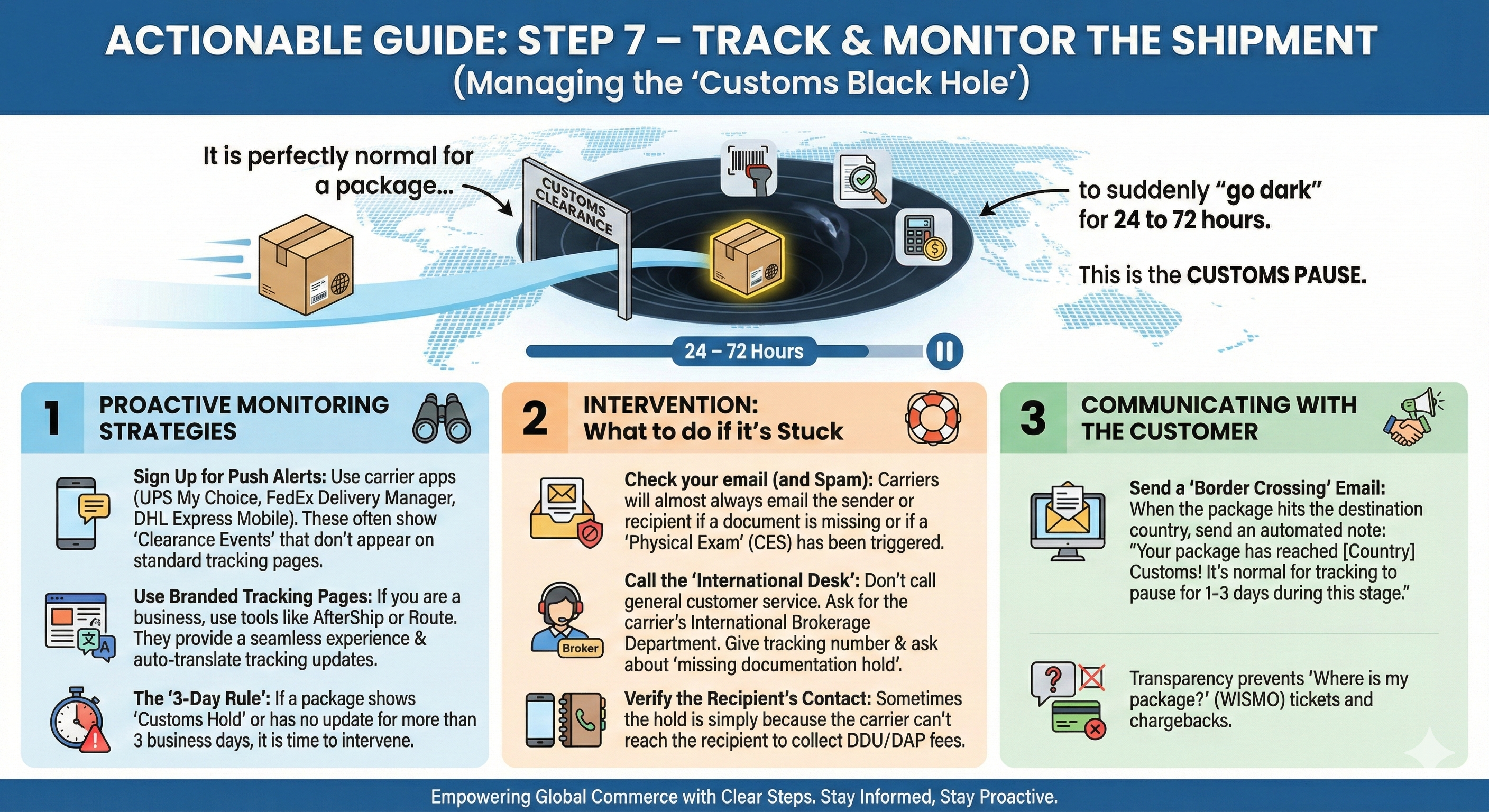
It is perfectly normal for a package that was moving rapidly across the globe to suddenly "go dark" for 24 to 72 hours. This is the Customs Pause. During this time, the package is being scanned, its data is being verified against your Commercial Invoice, and any duties are being assessed.
1. Proactive Monitoring Strategies
Don't just check the tracking link once a day. Use these tools to stay ahead of issues:
Sign Up for Push Alerts: Use carrier apps (UPS My Choice, FedEx Delivery Manager, or DHL Express Mobile). These often show "Clearance Events" that don't appear on standard tracking pages.
Use Branded Tracking Pages: If you are a business, use tools like AfterShip or Route. They provide a seamless experience for the customer and can auto-translate tracking updates from foreign postal carriers.
The "3-Day Rule": If a package shows "Customs Hold" or has no update for more than 3 business days, it is time to intervene.
2. Intervention: What to do if it’s Stuck
If the delay exceeds several days, it usually means a human officer needs more information.
Check your email (and Spam): Carriers will almost always email the sender or recipient if a document is missing or if a "Physical Exam" (CES) has been triggered.
Call the "International Desk": Don't call general customer service. Ask for the carrier’s International Brokerage Department. Give them the tracking number and ask specifically if there is a "missing documentation hold."
Verify the Recipient's Contact: Sometimes the hold is simply because the carrier can't reach the recipient to collect DDU/DAP fees.
3. Communicating with the Customer
Transparency prevents "Where is my package?" (WISMO) tickets and chargebacks.
Send a "Border Crossing" Email: When the package hits the destination country, send an automated note: "Your package has reached [Country] Customs! It’s normal for tracking to pause for 1-3 days during this stage."
The Expert Safety Net: When to Use a Local Shipping Store
(Professional Validation)
While DIY shipping is possible, a local "Pack and Ship" store (like The UPS Store, FedEx Office, or independent DHL partners) provides a layer of human verification that software cannot always match.
You should use a local shipping store if:
The Item is "Odd": Irregularly shaped, extremely fragile, or high-value items benefit from professional packing that meets carrier insurance requirements.
The Destination is "Difficult": Some countries have volatile customs environments or unique "Import Licenses" required. Local experts often have real-world data on which carriers are currently clearing customs fastest in specific regions.
You are Unsure of "Restricted Goods": Beyond the obvious (batteries, liquids), many countries ban specific items like certain textiles, wooden products, or even used electronics. A local store can run a "Compliance Check."
What They Verify for You:
Packaging Compliance: They ensure your "Shake Test" (Step 4) passes and use industrial-grade materials.
Document Auditing: They review your Commercial Invoice (Step 5) for vague descriptions that might trigger a customs hold.
Carrier Selection: They can compare real-time rates between DHL, FedEx, and UPS to find the best balance of speed vs. cost.
Need Help Shipping Internationally?
Our team provides full international shipping support, including packaging, documentation, and carrier selection in Elizabethtown, KY.
Come See us in Elizabethtown, KY
Visit or contact our location for help shipping your package overseas correctly the first time.


